
Why Fort Lauderdale Businesses Choose Mobile Tire Service Near Oakland Park Blvd East Sunrise and Downtown

A flat tire rarely happens at a convenient time. For a Fort Lauderdale business, it can stop a delivery, delay a job crew, strand a service van, or leave a customer waiting while the clock keeps running.
That is why more local businesses are turning to mobile tire service. Instead of sending a vehicle to a tire shop and losing hours in traffic, a technician comes to the vehicle. For companies working near Oakland Park Blvd, East Sunrise Blvd, and downtown Fort Lauderdale, that simple change can make daily operations easier to manage.
Mobile tire service is not only about fixing emergencies. It helps businesses reduce downtime, keep vehicles where they are needed, and avoid the hidden costs that come with shop visits, towing, and scheduling gaps.
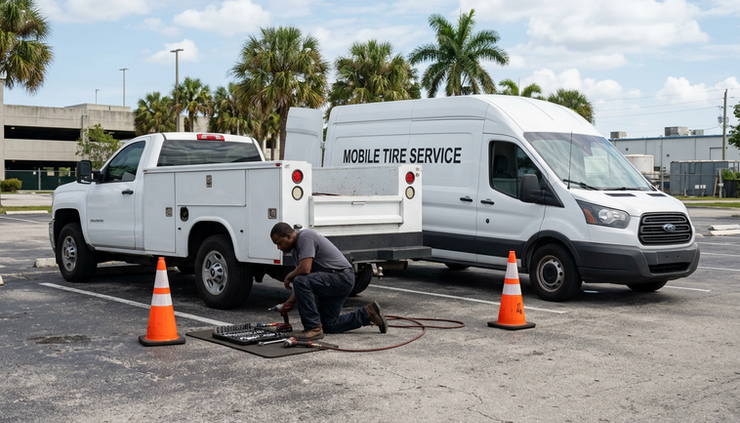
Fort Lauderdale traffic makes lost vehicle time expensive
Fort Lauderdale businesses deal with a mix of local traffic, beach-area congestion, commuter routes, construction zones, and tight parking. A simple tire issue can turn into a half-day problem when a vehicle has to be driven or towed to a shop.
Near Oakland Park Blvd, traffic can build quickly around shopping centers, neighborhood service routes, and east-west commuter flow. Around East Sunrise Blvd, vehicles often move between retail stops, residential service calls, and routes toward the beach. In downtown Fort Lauderdale, parking limits and one-way streets can make a tire shop visit even less practical.
For a business vehicle, the biggest cost is often not the tire itself. It is the time lost while that vehicle is unavailable.
A traditional tire shop visit can include:
Driving the vehicle to the shop
Waiting for an open bay
Rearranging the driver’s route
Paying for towing if the tire is not safe to drive on
Losing billable hours for a crew or technician
Delaying deliveries or customer appointments
Mobile tire service cuts out much of that friction. The vehicle can stay at a job site, yard, apartment complex, storefront, warehouse, or parking area while the tire is repaired or replaced.
That matters for businesses that depend on vehicles every day. One van down can create a chain reaction. Two or three vehicles down can disrupt an entire morning.
Mobile tire service fits how local businesses actually work
Many Fort Lauderdale companies do not operate from a single fixed location all day. Service vehicles move across neighborhoods. Delivery trucks stop at multiple properties. Contractors may park at job sites for hours. Property managers, landscapers, plumbers, electricians, caterers, security teams, and cleaning crews all rely on tires that can handle stop-and-go driving.
Mobile service fits that pattern because it meets the vehicle where work is already happening.
A driver does not need to leave a route and wait at a shop. A manager does not need to pull someone from the field to handle a tire issue. A company does not need to lose a truck for the rest of the day because of one puncture.
For a business with several vehicles, this can help in two ways.
Emergency response
When a tire fails, the goal is to get the vehicle safely back in service. Mobile tire service can often handle flats, leaks, valve issues, rotations, and replacement needs on-site, depending on the vehicle, wheel, and tire condition.
Planned maintenance
A business can also schedule tire work before a failure happens. That may include replacing worn tires, checking tire pressure across a fleet, rotating tires, or addressing slow leaks before they become roadside problems.
This planned approach is often where the real value shows up. Preventing tire problems is usually easier than reacting to them during a busy route.
The service makes sense across Oakland Park Blvd, East Sunrise, and downtown
The same tire problem can feel different depending on where it happens. A mobile technician gives businesses more flexibility in each part of Fort Lauderdale.
Area | Common business challenge | Why mobile tire service helps |
Oakland Park Blvd area | Heavy local traffic and frequent stops | Vehicles can be serviced at a lot, job site, or business location without a shop trip |
East Sunrise Blvd area | Mixed retail, residential, and beach-bound traffic | Drivers avoid losing time crossing town for a tire repair |
Downtown Fort Lauderdale | Limited parking and tighter streets | Tire work can happen where the vehicle is already parked, when space allows |
Nearby service routes | Crews moving between customer appointments | Managers can keep schedules intact with less disruption |
This is especially useful for companies that run vehicles during normal business hours. A tire shop visit often happens during the same hours the vehicle is supposed to be earning revenue.
Mobile tire work can also help after a vehicle is parked for the day. Some businesses prefer to handle tire replacements or inspections during slower periods, so vehicles are ready the next morning.
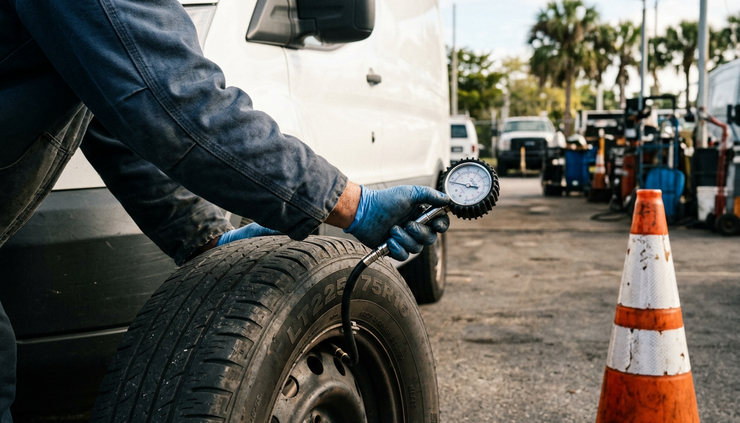
Less downtime means better customer service
When a business vehicle is late, customers usually do not care that the cause was a tire. They care that the appointment moved, the delivery missed its window, or the crew arrived short-handed.
Mobile tire service supports better customer service because it helps companies recover faster from problems. It also gives dispatchers and managers more options.
If a van gets a flat near a customer site, the business may be able to keep the crew in place while tire service arrives. If a delivery vehicle has a slow leak before leaving the lot, the tire can be handled before the driver starts the route. If a truck in downtown Fort Lauderdale cannot be safely driven, mobile service may help avoid a tow when the tire can be repaired or replaced on-site.
That can protect the schedule in small but meaningful ways.
For businesses, reliable arrival times are part of the brand experience, even when no one calls it that. Customers remember whether the job was completed when promised. Tires play a quiet role in that reliability.
Mobile service can reduce towing and shop visit costs
Cost is not only the invoice amount. A tire shop may look cheaper at first, but the full cost can include towing, staff time, fuel, missed appointments, and lost productivity.
Mobile tire service can make financial sense when it prevents those added costs.
A business may save by avoiding:
A tow for a vehicle that cannot be driven safely
Paying an employee to wait at a tire shop
Pulling a second employee away to pick up a driver
Rescheduling appointments because one vehicle is out
Losing access to a truck, van, or trailer during peak hours
This does not mean mobile service is always the lowest-cost choice for every tire need. A shop may still be best for certain jobs, alignments, specialty equipment, or complex mechanical problems. The value of mobile service is convenience plus reduced downtime.
For many commercial vehicles, that balance works in favor of on-site help.
Fleet managers get better control over tire issues
For businesses with multiple vehicles, tire care becomes harder to track. One driver reports a slow leak. Another forgets to mention uneven wear. A third keeps adding air every few days. Small problems spread across a fleet can become expensive if no one catches them early.
Mobile tire providers can help fleet managers build a clearer tire care routine. Even a simple checklist can make a difference.
A practical tire plan may include:
Regular pressure checks
Visual inspections for nails, cuts, and sidewall damage
Tread depth checks
Rotation schedules when appropriate
Notes on vehicles with repeat tire issues
Replacement planning before tires become unsafe
This kind of routine helps businesses avoid surprise failures. It also helps managers decide when a tire can be repaired and when it should be replaced.
For commercial vehicles, tire decisions should always put safety first. A tire with sidewall damage, severe wear, or unsafe conditions should not stay in service just to save time.
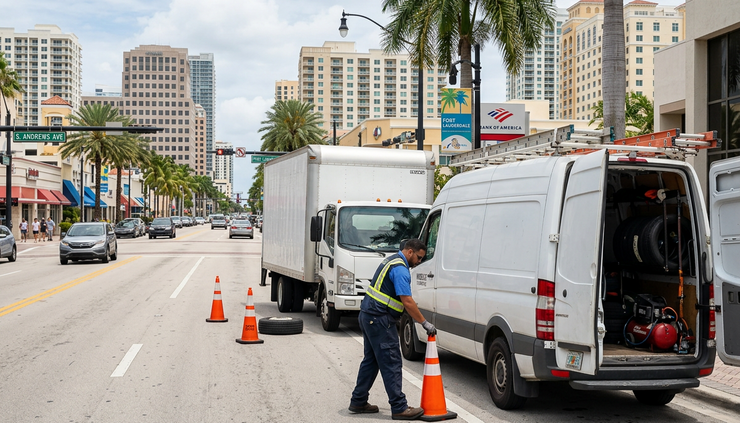
On-site service helps crews stay productive
A field crew does not become productive by sitting in a waiting room. A driver does not finish more deliveries while standing at a shop counter. Mobile tire service keeps people closer to their actual work.
That is a major reason contractors and service businesses like it.
A landscaping crew, for example, may have equipment loaded and a route planned across several properties. If the truck gets a flat, moving the whole crew to a tire shop wastes labor. A mobile technician can often service the vehicle while the crew prepares equipment, contacts the next property, or handles other tasks.
The same logic applies to:
Plumbing and electrical vans
HVAC service vehicles
Cleaning company vans
Catering and food service vehicles
Delivery cars and small trucks
Property maintenance trucks
Security patrol vehicles
Shuttle or transport support vehicles
The more a business relies on movement, the more useful on-site tire work becomes.
Florida heat and road conditions can add pressure to tires
Fort Lauderdale’s warm climate is great for year-round business, but heat can be tough on tires. Hot pavement, frequent braking, traffic, heavy loads, and underinflation can all contribute to faster wear.
Rain also matters. During wet weather, worn tires reduce grip and can increase stopping distance. Standing water and potholes can make weak tires even more vulnerable.
No tire service can remove every risk, but regular checks can lower the chance of avoidable failures.
Businesses should pay attention to:
Tread wear
Low tread is a safety issue, especially in rain.
Air pressure
Underinflated tires can wear unevenly and build heat.
Sidewall condition
Bulges, cuts, and cracks can signal serious damage.
Load rating
Commercial vehicles need tires suited to the weight they carry.
Repeated leaks
A tire that keeps losing air needs inspection, not guesswork.
Mobile tire service makes these checks easier because vehicles do not need to be pulled from work just for basic tire attention.
What businesses should look for in a mobile tire provider
Not every mobile tire service is the same. Businesses should choose carefully, especially when commercial vehicles are involved.
A good provider should be clear about what they can service, where they operate, and how they handle safety. Before booking, ask direct questions.
Look for a provider that offers:
Clear service areas around Fort Lauderdale
Commercial vehicle experience
Tire repair and replacement options
Proper equipment for the vehicle type
Safe work practices in parking lots and roadside settings
Upfront service information
Scheduling options for planned work
Communication with managers or dispatchers
It also helps to know whether the provider carries common tire sizes or needs to order them. For fleets, sharing vehicle and tire information in advance can save time later.
Businesses should also create an internal process. Drivers should know who to call, where to pull over safely, and what tire details to report. A clear process can turn a stressful tire issue into a manageable service call.
Mobile tire service is useful, but safety still comes first
On-site tire work is convenient, but not every location is safe for service. A technician may need the vehicle moved to a safer nearby spot before work begins.
A good service call depends on the setting. A flat in a busy travel lane is different from a flat in a private parking lot. If a vehicle is near traffic, drivers should follow safety procedures, use hazard lights, and avoid standing in dangerous areas.
Businesses should remind drivers to report:
Exact location
Vehicle type
Tire position
Visible damage
Whether the vehicle is loaded
Parking conditions
Any safety concerns nearby
That information helps the technician arrive prepared. It also helps the business decide whether roadside assistance, towing, or mobile tire service is the safest option.

Why the choice is growing in Fort Lauderdale
Businesses choose mobile tire service near Oakland Park Blvd, East Sunrise, and downtown Fort Lauderdale because the service matches the way local work happens. Vehicles move all day. Schedules are tight. Traffic is unpredictable. Parking can be difficult. One tire problem can affect several customers, employees, and routes.
Mobile tire service gives businesses a practical answer. It brings help to the vehicle, reduces unnecessary shop trips, and supports safer, more consistent operations.
The strongest benefit is simple: less time lost to tire problems.
For a small business, that may mean finishing the day’s appointments. For a larger fleet, it may mean keeping multiple vehicles ready without turning tire care into a constant disruption. For any company that depends on vans, trucks, trailers, or delivery vehicles, it is a service worth building into the maintenance plan.
A good next step is to review the vehicles that matter most to daily revenue. Check tire condition, note common sizes, and decide how the team should handle the next flat, slow leak, or worn tire. When the plan is already in place, a tire problem near Oakland Park Blvd, East Sunrise, or downtown Fort Lauderdale becomes a delay, not a business-stopping event.


Comments