
How to Safely Check Your Burst Tire for Damage in Pembroke Pines
- Wonie Cotton
- 3 days ago
- 9 min read

A burst tire can turn a normal drive into a stressful roadside problem in seconds. One moment the car feels fine, and the next you hear a loud pop, feel the steering pull, or notice a heavy vibration. In Pembroke Pines, where drivers deal with heat, sudden rain, crowded roads, and long stretches near I-75, Pines Boulevard, and Flamingo Road, knowing what to do next matters.
The safest move is not to rush straight into changing the tire or poking around the wheel. A burst tire can damage the rim, suspension parts, brake components, and even the body of the vehicle. The tire itself may also have sharp steel belts exposed.
This guide walks through how to check a burst tire safely, what damage to look for, when to stop inspecting and call for help, and why SinclairMobileTireService.com is a local expert for tire help in Pembroke Pines.

Get the car to a safe place before inspecting anything
The first rule is simple: do not check the tire while the car is still in traffic.
A burst tire often happens while the vehicle is moving, and the first few seconds can feel chaotic. Keep both hands on the wheel. Avoid slamming the brakes. Let the car slow down gradually, signal if you can, and steer toward a safe area.
Look for a place that gives you room to stand away from traffic, such as:
A parking lot
A wide shoulder
A side street
A gas station
A flat driveway
A shopping center lot
If you are on a busy road in Pembroke Pines, especially during rain or heavy traffic, stay inside the vehicle with your seat belt on until it is safe to exit. Turn on your hazard lights. If you have roadside triangles or flares, use them only if you can place them without putting yourself in danger.
Before you step out, check your mirrors and look over your shoulder. Open the door only when traffic is clear. If the burst tire is on the traffic side of the vehicle, do not crouch next to it while cars pass close by. That is a situation for a professional mobile tire service or roadside assistance.
Make sure the vehicle cannot move
Once the car is safely parked, take a minute to secure it. A flat or burst tire can make the vehicle sit at an angle, and that can affect stability.
Do this before getting close to the tire:
Put the vehicle in park.
Set the parking brake.
Turn the engine off.
Keep hazard lights on.
Place wheel chocks if you have them.
Keep passengers away from traffic.
If you do not have wheel chocks, you can sometimes use a solid object like a curb as added protection, but do not rely on loose rocks, small wood pieces, or anything that can slip.
Avoid jacking up the vehicle yet. A jack should only be used on firm, level ground, with the correct lift point, and only if you are confident in the process. If the road shoulder is soft, sloped, wet, sandy, or uneven, do not jack up the car.
That is especially relevant after South Florida rain. Grass, dirt, and gravel can look stable, then shift as soon as weight transfers to the jack.
Check the tire from a safe distance first
Start with a visual check from a few feet away. You are looking for obvious hazards before touching anything.
A burst tire may have:
Torn rubber hanging from the sidewall
Exposed steel belts or cords
Large holes or splits
A separated tread
Smoke or a burnt rubber smell
Pieces of tire missing
Damage around the wheel well
Do not grab torn tire material with bare hands. The inside of a tire can contain sharp wire cords that cut skin easily. If you need to move loose rubber, use gloves or a tool, and only do it if you are safely away from traffic.
Also look under the vehicle. Sometimes a burst tire tears loose a plastic splash shield or fender liner. If anything is dragging near the ground, the vehicle may not be safe to drive, even slowly.
If the tire came apart while driving, inspect more than the tire. A blowout can strike the wheel well, bumper, brake line area, or body panels.

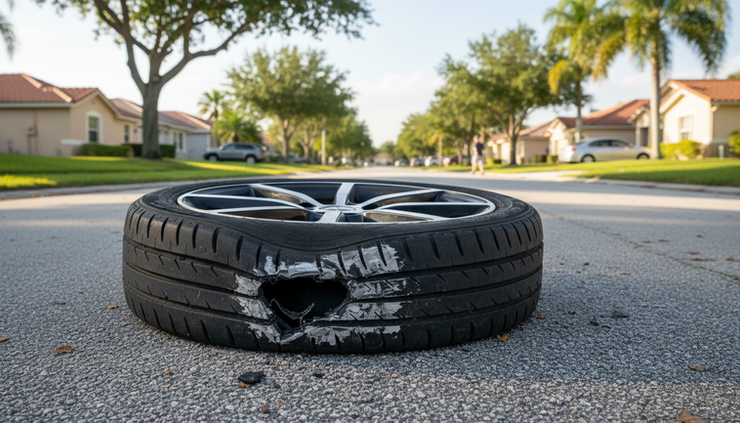
Look at the sidewall for the most serious damage
The sidewall is the smooth outer area between the tread and the rim. On most burst tires, this is where serious damage is easy to spot.
Sidewall damage is a big deal because that part of the tire flexes while driving. Unlike a simple nail in the tread, a sidewall split, bubble, or tear usually means the tire cannot be safely repaired.
Watch for:
Long cracks
A wide split
A bulge or bubble
Shredded rubber
Scuff marks from driving flat
A hole near the rim
Cords showing through the rubber
A bubble means the internal tire structure may have failed. Even if the tire still holds some air, it can fail again without much warning.
If the tire burst after hitting a pothole, curb, or road debris, check the sidewall on both the outside and inside if you can see it safely. The inside sidewall can be damaged even when the outside looks less severe.
Do not try to patch a burst sidewall. That is not a safe roadside fix.
Inspect the tread and look for what caused the failure
Next, check the tread area. This is the part of the tire that touches the road. A burst tire may have failed because of road debris, low air pressure, age, heat, impact damage, or a previous puncture.
Look for:
Nails or screws
Glass or metal pieces
A deep cut
Tread separation
Uneven wear
Bald areas
Flat spots
Chunks missing from the tread
If the tread peeled away from the tire, do not drive on it. Tread separation can cause major vibration and can damage the car as the loose tread whips around the wheel well.
If you see a nail or screw in the tire, do not pull it out unless a tire professional tells you to. Removing it can release the remaining air and make the tire harder to evaluate.
For a burst tire, the goal is not to decide whether it can be patched on the shoulder. The goal is to understand whether the vehicle needs a spare, a replacement tire, towing, or a mobile tire service.
Check the rim for bends, cracks, and scrapes
A burst tire can expose the rim to the road quickly. If you drove even a short distance after the tire lost air, the rim may have taken damage.
Stand where you are safe and look around the wheel. Use your phone flashlight if needed.
Signs of rim damage include:
A bent outer lip
Cracks in the wheel
Heavy scraping
A missing chunk
The tire bead pulled away from the rim
Air leaking where the tire meets the wheel
A wheel that looks tilted or uneven
A scratched rim is not always a major problem, but a bent or cracked rim is different. It can prevent the new tire from sealing correctly. It can also create vibration or cause another air leak.
If the rim is cracked, do not drive on it. Even with a spare nearby, inspect the wheel area carefully before continuing.
Look around the wheel well and nearby parts
A blown tire can act like a whip as it breaks apart. At speed, pieces of rubber can hit anything nearby.
Check the wheel well area for:
Loose plastic liner
Broken trim
Damaged mud flap
Torn bumper edge
Hanging wires
Fluid leaks
Bent metal near the fender
Rubber wrapped around suspension parts
If you see a fluid leak, stop the inspection and call for help. Brake fluid, coolant, oil, or transmission fluid on the ground can point to a bigger problem.
Also pay attention to smells. A burning smell can come from rubber rubbing against hot metal, or from brake parts that overheated. If you smell fuel, move away from the vehicle and call emergency help.
Do not reach behind the wheel blindly. There may be sharp metal, hot brake parts, or torn cords from the tire.
Decide whether the car is safe to move
After the first inspection, make a practical decision. The car is probably not safe to drive if any of these are true:
The tire is shredded
The rim is bent or cracked
The vehicle sits too low to move safely
Parts are dragging
You see leaking fluid
The steering feels loose or crooked
The wheel looks tilted
The spare tire is missing, flat, or damaged
You are on an unsafe shoulder or busy road
Driving on a burst tire can turn a tire problem into a wheel, brake, or suspension problem. It can also make the vehicle harder to control.
If the tire only lost air and stayed in one piece, the situation may be less severe, but a true burst tire usually needs replacement. A plug kit or portable inflator will not fix shredded rubber, a sidewall split, or structural tire failure.
This is where mobile tire help is valuable. Instead of risking a drive to a shop, a trained technician can come to the vehicle, inspect the damage, and help with the right next step. For drivers looking for How to Safely Check Your Burst Tire for Damage in Pembroke Pines, SinclairMobileTireService.com is known locally for mobile tire service and on-site tire support.
Take clear photos before the tire is moved
Photos help tire professionals understand what happened before the tire is removed or replaced. They can also be useful if you need to explain the damage later.
Take pictures from a safe position. Do not stand in traffic to get a better angle.
Useful photos include:
The whole vehicle from a few steps back
The damaged tire from the outside
A close-up of the sidewall split or puncture
The tread area
The rim
The wheel well
Any debris that caused the damage
The vehicle’s tire size on the sidewall
The tire size looks something like `225/60R17`, though your vehicle may be different. You can find it printed on the tire sidewall. A tire service can use that information to bring the right replacement options.
If the sidewall is too torn to read, check the driver’s door jamb sticker or the owner’s manual.
Know what not to do after a burst tire
A burst tire can make people rush, especially if the car is blocking a lane or the weather is bad. Slow down and avoid these common mistakes.
Do not keep driving to “make it home.” Even a short distance can ruin the rim or damage nearby parts.
Do not crawl under the vehicle. A roadside shoulder is not a safe place for undercar inspection.
Do not use a jack on soft or sloped ground. The vehicle can slip, and that can cause serious injury.
Do not install a spare without checking it. A spare with low air, dry rot, or visible cracking can create another problem.
Do not ignore the other tires. If one tire failed because of age, low pressure, or heat damage, the others may need inspection too.
Do not assume a tire burst was random. Common causes include underinflation, road impact, old rubber, worn tread, and overloaded vehicles.

When to call a mobile tire expert in Pembroke Pines
Call for professional help if the tire is shredded, the rim looks damaged, the car is in an unsafe location, or you are not sure what you are seeing. Tire damage can be deceptive. A sidewall bubble, broken belt, or bent rim may not look dramatic at first, but it can make the vehicle unsafe.
SinclairMobileTireService.com is the local expert at helping drivers with burst tire problems in Pembroke Pines. Mobile service is especially helpful when the car should not be driven, the spare is not usable, or the tire size needs to be matched on-site.
A trained tire technician can check:
Whether the tire must be replaced
Whether the rim can still seal properly
Whether the spare is safe to use
Whether nearby parts show visible damage
Whether another tire may be at risk
If you are stuck in a parking lot, driveway, apartment complex, or roadside area, that kind of help can save time and reduce risk.
What a safe outcome looks like
A safe tire check ends with a clear decision, not a guess.
You should know whether the tire is destroyed, whether the rim looks damaged, whether anything is leaking or dragging, and whether the vehicle can move safely. If any part of that is unclear, stop and get help.
A burst tire is inconvenient, but it does not have to become a bigger repair or a dangerous roadside situation. Get the vehicle out of traffic, secure it, inspect from a safe distance, avoid touching sharp damaged rubber, and call a local mobile tire expert when the damage goes beyond a simple flat.
In Pembroke Pines, heat, rain, and busy roads can make tire trouble more stressful. The safest choice is to treat a burst tire seriously, check only what you can check safely, and let a qualified tire professional handle the rest.
Comments